
Have you ever found yourself reacting to something before you’ve had a chance to think it through?
Perhaps someone says something that hits a nerve. Your stomach tightens, your heart starts racing, or suddenly you feel an overwhelming need to respond. You might even recognize afterward that your reaction was bigger than the situation itself.
You’re not alone.
Sometimes our bodies respond to what’s happening around us before our minds have had a chance to catch up. And sometimes what we’re feeling in the present is connected to experiences, emotions or wounds from the past.
One of the things I love about Emotional Freedom Techniques (EFT), also known as tapping, is that it can help us become more aware of what’s happening within us and develop tools to navigate those moments differently.
Recently, a client shared her experience of learning EFT and incorporating tapping into her everyday life. I wanted to share her story because it beautifully illustrates something important: emotional regulation isn’t about never feeling overwhelmed. It’s about learning how to recognize what’s happening and giving yourself a little more choice in how you respond.
Recognizing the Signs of Nervous System Activation
My client described something I suspect many people will recognize.
For her, nervous system activation often felt like urgency. Almost as if all the cylinders in her body were running at once.
She experienced restlessness, butterflies in her stomach and an internal feeling that something needed to happen or that she needed to respond.
Before learning these tools, she didn’t always recognize what was happening in her body. She simply experienced the feeling and responded from that place.
Sound familiar?
When our nervous system becomes activated, it can be difficult to slow down, think clearly and decide how we actually want to respond.
Learning to recognize those early signals can be an important first step.
Creating Space Between Feeling and Reacting
One of the biggest changes my client described was learning to pause.
Instead of immediately reacting when something triggered her, she began noticing what was happening inside her.
She learned to take a breath, bring her attention back to the present moment and give herself permission to wait before responding.
She shared a reminder that has become particularly meaningful to her:
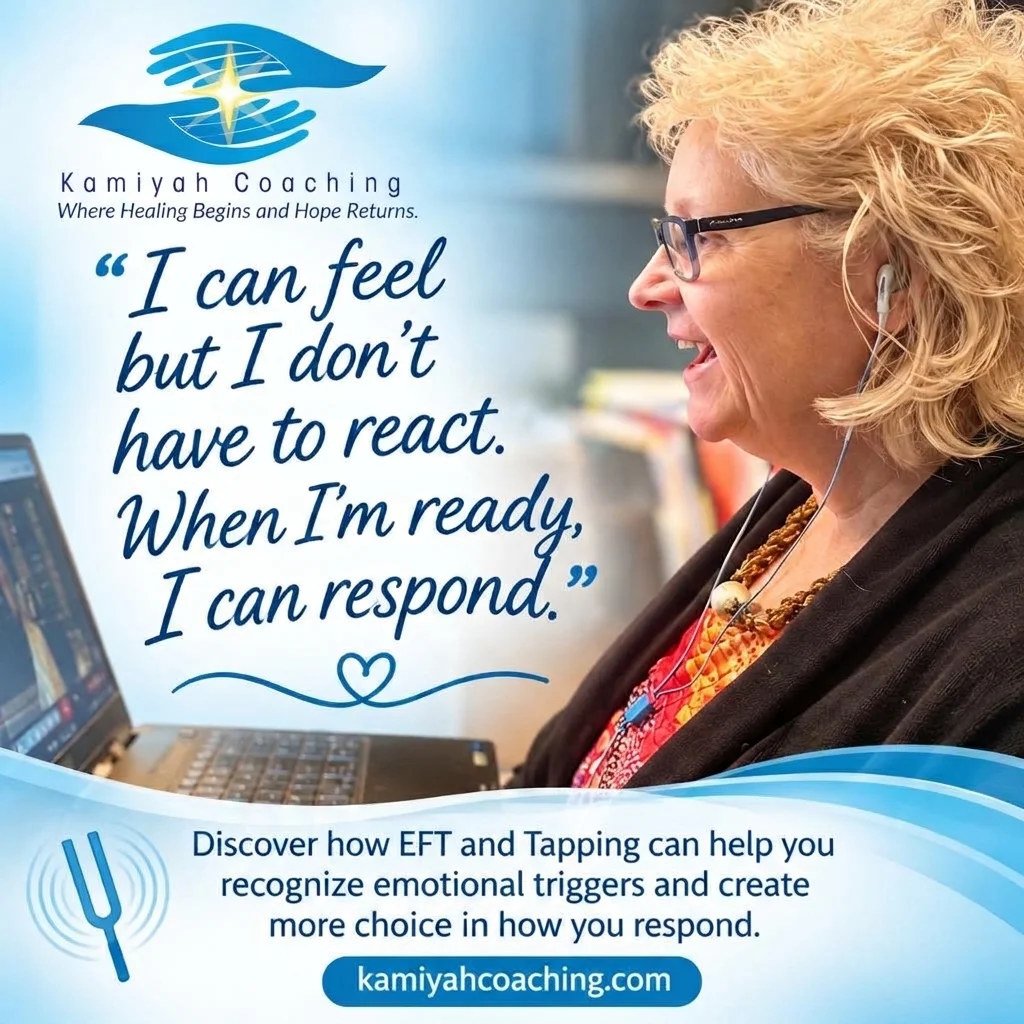
“I can feel but I don’t have to react. When I’m ready, I can respond.”
I love this.
Think about how empowering it can be to realize that you can experience an emotion without allowing that emotion to make every decision for you.
You can feel hurt without immediately responding from that hurt.
You can feel frustrated without getting pulled into an argument.
You can feel anxious and still give yourself time to decide what you need.
That doesn’t mean ignoring your emotions. It means making room for them without allowing them to completely take over.
EFT and Tapping: Tools You Can Use in Everyday Life
One of the things my client appreciated about learning EFT was discovering that she didn’t always need to sit down for a formal tapping session.
She found ways to incorporate what she’d learned into everyday situations.
Sometimes she would gently rub her hands together under the table or rest them in her lap while having a difficult conversation.
She also practised the tapping point sequence independently, becoming more familiar with the points and discovering ways to make the practice her own.
This is something I particularly love about teaching EFT.
The goal isn’t to become dependent on having someone guide you through every difficult moment. It’s about learning tools you can begin to use independently, when appropriate, as part of your own self-care.
EFT combines focused attention on emotions or experiences with gentle tapping on specific points on the body. Many people use it as a way to explore emotional experiences, manage stress and develop greater awareness of their responses.
And you don’t have to wait until you’re completely overwhelmed to start practising.
Emotional Regulation Doesn’t Mean Suppressing Your Feelings
This is an important distinction.
Emotional regulation isn’t about pretending everything is fine, pushing difficult feelings away or becoming someone who never gets upset.
My client was very clear about this in her testimonial.
She still experiences hurt, anger and anxiety. Difficult conversations haven’t suddenly become easy.
What has changed is her growing awareness of what’s happening within her and her ability to give herself time and space before responding.
She’s learning that she doesn’t have to get pulled into old feelings simply because something in the present reminds her of the past.
That’s a meaningful shift.
It’s not about controlling other people or everything that happens around us. It’s about developing a better relationship with ourselves.
Small Steps You Can Start Practising Today
You don’t need to make big changes to begin becoming more aware of your body’s signals.
Here are a few simple things you can try:
1. Notice your breathing.
When you feel yourself becoming activated, pause and notice your breath. Allow yourself a moment before deciding what to do next.
2. Feel your feet on the floor.
Bring your attention to the physical sensation of your feet connecting with the ground. This can help bring your attention back to the present moment.
3. Notice what’s happening in your body.
Are your shoulders tense? Is your stomach tight? Are you feeling restless? Simply noticing can be a valuable starting point.
4. Give yourself permission to pause.
You don’t have to answer immediately. You don’t have to resolve every disagreement in the moment. Sometimes the most helpful response is to give yourself a little time.
5. Explore EFT and tapping.
Learning the tapping points and practising gentle techniques can give you another tool to explore when emotions feel overwhelming.
Learning to Feel Without Being Controlled by Your Feelings
What I took away from my client’s experience is that this journey isn’t about becoming a different person.
It’s about understanding yourself a little better.
It’s about recognizing when your body is sending signals, learning what you need in those moments and discovering that you have choices.
And perhaps most importantly, it’s about being kind to yourself along the way.
There is no expectation that you’ll get it right every time. This is a practice, and like any new skill, it takes time.
At Kamiyah Coaching, I love helping people explore EFT and other supportive tools that can help them reconnect with themselves, develop greater self-awareness and navigate life’s challenges with more intention.
If you’re curious about EFT and wondering whether it might be something you’d like to explore, I’d love to introduce you to it.
You don’t have to wait until you’re overwhelmed to start learning how to care for yourself.
Where Healing Begins and Hope Returns.
Explore EFT and Tapping with Kamiyah Coaching
Visit kamiyahcoaching.com or arrange a complimentary introductory EFT session here.
EFT and tapping are complementary self-care approaches and are not a substitute for medical or psychological care. Individual experiences vary.